Shamu
Shamu is born in the hill-village of Qir-Nael, a mixed settlement where satyrs and humans coexist uneasily on the eastern skirts of the Glasspine Range. Her mother, Idria, is a human costume-maker for traveling troupes; her father, Varos, is a satyr clarinetist known for his improvisations on funeral marches. Shamu’s birth is contentious. Idria is already betrothed to a human carpenter when she conceives Shamu with Varos during a touring festival. The village council debates whether a horned hybrid should be registered as satyr or human for taxation and conscription rolls. Varos insists she is satyr; Idria, hoping for some measure of respectability, attempts to declare her human. The midwife, confronted with Shamu’s budding horns and cloven feet, records her as “caprine citizen,” a category mostly used for itinerant goatherds and considered legally marginal.
From age three, Shamu displays an unusual stillness for a satyr child. While others chase each other through the terraced vineyards, she watches adults argue about land boundaries, inheritance, and festival permits. She learns to mimic their tones: the calculated softness of the priest, the clipped righteousness of the elders, the tired fury of her mother. At five, she constructs a makeshift stage from fruit crates in Idria’s work shed, forcing neighborhood children to reenact overheard arguments. She directs them with a severity that adults describe as “unsettling.” Her father encourages her to dance to his clarinet instead, hoping to nudge her toward performance rather than conflict. She dances, but only after negotiating: she demands two copper pieces per rehearsal, and a guarantee that her name is announced before his.A turning point occurs when she is eight. During the Harvest Rite, children are expected to offer a gesture of thanks to the village god, Lethen of the Stones. Shamu, in a costume she designs herself with Idria’s discarded silks, walks onto the communal platform and recites a speech she claims Lethen has given her in a dream. The speech criticizes the council for selling grazing rights to a distant baron and warns that “stone remembers bargains, even those not carved into it.” The crowd is amused at first, then offended as she lists specific council members’ side gains. Varos, realizing how she has listened at the edges of adult conversations, drags her from the platform. She is whipped privately by her mother for “talking like you are more than you are.” That night, Shamu’s anger crystallizes. She understands that truth and performance are separate commodities, and that the former is punished while the latter is applauded only when it flatters power.
Her training as an entertainer begins formally at ten, when a traveling company called the Redveil Caravan loses a dancer to illness and scans the village for a replacement. Shamu auditions uninvited, performing a silent portrayal of a dying oak tree that shifts into a woman and then into a laughing girl. Her control of gesture, the precision of her glances, and the disquiet she causes in the onlookers impress the caravan’s mistress, a retired illusionist named Larga Vint. Larga offers a conditional apprenticeship: Shamu can join if Idria signs a liability waiver and if Shamu consents to horn capping, a fashionable practice among city satyrs that sheers and plates the horns to appear slimmer and more “civilized.”
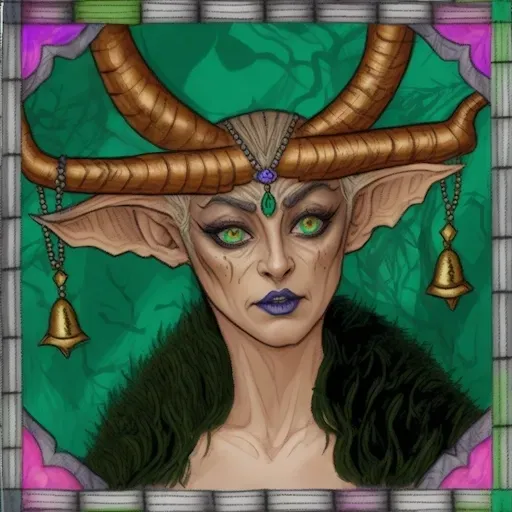
Idria signs, motivated as much by the chance to rid herself of a difficult child as by the coins promised. Varos objects, but he has no formal claim, having never married Idria. Shamu agrees to the horn capping, then bites the apprentice jeweler during the procedure. The scar on his wrist becomes a minor gossip item among caravan circles. Shamu’s horns emerge from the capping process thinner, gleaming with copper plates etched in whorl patterns. The effect is striking. She grows into a figure whose beauty is intensified, not softened, by the metallic ferocity of her horns.
Within the caravan, she discovers the mechanics of structured entertainment: timing, misdirection, lighting, rumor-seeding, and staged spontaneity. Larga teaches her how audiences respond differently to the same gesture depending on what has been whispered about the performer beforehand. Shamu proves adept at managing this invisible prelude. In each new town, she selects a rumor to trail behind her: in one, that she is a foreign princess sold into performance; in another, that she used to be a tree and will wither if not applauded; in another, that she was born with no shadow and steals others’ when they sleep. She treats herself as an evolving narrative object and monitors how expressions change as she passes.
Anger remains a constant thread. Shamu does not flare quickly; instead, she stockpiles affronts. A drunken patron who grabs her wrist during a curtain call is later denied entrance to the show via a forged decree suggesting he is under investigation for temple theft. A rival dancer who mocks her cloven feet finds her shoes stuffed, night after night, with crushed nettles, leading to delayed performances and eventual dismissal. In each case, Shamu avoids open confrontation and seeks outcomes that preserve her image as charming and enigmatic while quietly removing or damaging those who offend her.
By seventeen, she transitions from dancer to full-stage manipulator. Larga entrusts her with planning the “bridging intervals,” the improvised sections between acts when the troupe must prevent patrons from leaving. Shamu devises a recurring persona named “Lady Anar,” a satirical aristocrat who speaks directly to audience members, extracts secrets with jokes, and uses them to fuel later punchlines. Under this veneer of comedy, Shamu collects usable information: who owes whom money, who despises the mayor, who visits the illegal herbalists. She maintains a coded notebook, written in a personal shorthand that mixes satyr glyphs with stage directions, listing faces, aliases, and leverage points.
The pivotal betrayal that shifts her from opportunistic manipulator to deliberate villain occurs during a performance in the copper-mining city of Brunsat. The caravan has secured a rare extended engagement in the miners’ guildhall under the patronage of Guildmaster Hark Mordel. Hark is infamous for underpaying his workers and funding mercenary crackdowns on strikes. Larga, who values stability over morality, instructs the troupe to avoid political commentary. Shamu agrees publicly, then undermines this in practice.
In the third week, she introduces a new interval routine for Lady Anar: a mock “court” where Hark is placed on a makeshift throne and “tried” for various comic “crimes.” The first two nights are light-hearted; workers enjoy seeing Hark teased, and Hark enjoys the air of magnanimity. On the third night, Shamu alters the script. She calls a miner’s widow onstage and has her read a “receipt” for her husband’s life, written by Shamu in exaggerated legalese but based on real mine accident reports that she has acquired with money and promises. The hall turns. The laughter drops. Shamu pushes further, forcing Hark publicly to “absolve himself” of responsibility. He refuses and storms out.
The following morning, mercenaries raid the caravans’ wagons. Hark claims the troupe has incited unrest; the city council, wary of strikes, issues a decree banning them from all guild properties. Larga confronts Shamu in private and demands an apology or, failing that, a confession to the authorities placing sole blame on herself, thus exonerating the caravan. Shamu refuses. In response, Larga announces that Shamu is expelled, effective immediately, and will forfeit all saved wages.
That night, the caravan’s payroll chest and Larga’s personal illusions codex vanish. Shamu leaves a forged confession in the handwriting of the troupe’s financial clerk, Valen Ri, suggesting he has fled with a local lover. Valen is jailed; he insists on his innocence, but the forged confession and Shamu’s clean wagon draw suspicion away from her. Within a week, she has already boarded a river barge under a new name. Later, she recounts this event as a necessary “rebalancing”: Larga took her youth, the caravan took her truth, so she took their future.
Shamu’s current occupation at twenty-four is a layered construct. On the surface, in the city of Telvar’s Reach, she is a stage hostess and “temper-keeper” at the House of Seven Glasses, an upscale performance hall known for elaborate mirrored illusions and carefully regulated vice. She introduces acts, moderates high-stakes wagers recorded on polished stone ledgers, and leads post-performance discussions with wealthy patrons in private tea salons. Her official title is “Mistress of Atmosphere,” a role that sits ambiguously between entertainer, ringmaster, and social coordinator.
Underneath this, Shamu operates an information and influence brokerage that uses the House of Seven Glasses as a collection net. She pays the stage technicians to adjust spotlight angles at key moments, illuminating or obscuring specific faces. She memorizes seating patterns, drink preferences, verbal tics of discomfort. Through a network of indebted assistants—waiters she has saved from gambling debts, actors whose secrets she has buried, cleaners whose wages she has increased by fractions timed to their loyalty—she funnels conversation snippets into structured reports. She sells these selectively to rival merchants, minor nobles, smugglers, and occasionally the city watch, always ensuring that no single client sees the entire map of what she knows.
Her betraying patterns are consistent: she aids only when the requested favor aligns with her own long-range designs. A merchant asks her to ruin a competitor’s opening night; she agrees, provided the merchant later funds a free festival in a poor ward that Shamu wants emotionally indebted to her. An actor begs her to help secure a coveted lead role; she does, but writes into the actor’s new contract a clause that routes a portion of their future commission to a shell persona she controls. Anyone who attempts to renege finds themselves socially dismantled, not through overt scandal but through a slow erosion of opportunity and reputation. Shamu prefers collapses that appear organic, like structures finally yielding to long-applied pressure.
Her romantic record is sparse in quantity but exacting in impact. She engages in relationships as experiments in vulnerability control. At nineteen, she becomes involved with a human stage-light engineer named Deren Koel. Deren is patient, earnest, and skilled at reading physical space but not emotional subtext. Their affair progresses in stolen moments between rehearsals. Shamu monitors how knowledge of this relationship changes the way she is treated by other cast members. When she notices a drop in the small but significant gestures of deference she has cultivated—chairs not immediately offered, jokes made more freely at her expense—she ends the relationship abruptly, citing boredom. Deren breaks down publicly. Shamu uses this as material, internalizing the lesson that her own openness decreases ambient fear, which she has come to equate with security.
At twenty-two, she has a more strategically entangled relationship with a satyr diplomat-in-training named Relin Thast. Relin is ambitious but naive regarding the city’s informal power structures. He is drawn to Shamu’s hybrid background and sees in her a bridge to both satyr and human spheres. Shamu, in turn, sees in Relin a future lever. She assists him with speechcraft, teaches him how to pivot under confrontation using performance techniques, and corrects his posture and timing in public appearances. As he rises, she inserts subtle dependencies: critical contacts that come through her, debts managed quietly by her accountants, rumors deflected by her whispering network.
The betrayal, when it comes, is clinical. A coalition of conservative satyr elders summons Relin to answer for a set of progressive proposals he has sponsored—proposals that Shamu herself drafted language for, emphasizing mutual concessions that undercut elder prerogatives. Under pressure, facing potential career collapse and exile from his caste, Relin turns to Shamu, expecting solidarity. She assesses the situation and determines that if he falls spectacularly, she can step around him into a newly opened niche as an unofficial cross-faction negotiator. In the hearing, when asked whether Relin’s speeches reflect broader satyr sentiment, Shamu testifies that he has “often misunderstood the heart of his people” and subtly distances herself from the proposals’ intent. Relin is reprimanded harshly, his trajectory blunted. Later, Shamu offers private consolation but no practical aid. Their bond ends, leaving Relin disillusioned and politically maimed.
Shamu has no husband and no formal marriages recorded under any of her known legal names. She has entered into two “season contracts,” a common urban arrangement that grants limited cohabitation and mutual legal protections for a fixed term, once with Deren and once with Relin. She dissolves both contracts before their natural expiration, paying the penalty fees herself to maintain the appearance that the other party failed to meet some unspecified standard. There is no known daughter nor any registered offspring; medical records from a discreet midwife in the Canal Ward indicate one terminated pregnancy at age twenty-three, accompanied by a notation that the client “expressed no regret, only relief and an unusual curiosity about blood volume and color.”
Her life credo is not publicly articulated as such, but patterns in her decisions and occasional remarks suggest a coherent underlying ethic. She appears to believe that power is an emergent property of perception and that the deepest injustice is to be accurately seen by those who can harm you. Hence, she protects her interior life with layered performances and ensures that anyone glimpsing a genuine fragment of her is either dependent on her or doomed. In conversation with a young actress panicking about a poor review, Shamu offers an unguarded formulation: “You are not what you are. You are what they arrange themselves around when you enter. Change that, and who you are becomes irrelevant.” The actress later recalls this line as both chilling and clarifying.
Shamu becomes increasingly involved in political intrigue as Telvar’s Reach enters a period of unstable transition. The aging First Regent, Marcell Idden, is rumored to be grooming several secret successors; the city’s major guilds and satyr clans position themselves accordingly. The House of Seven Glasses, as a hub of elite entertainment, evolves into an unofficial negotiation ground. Ambassadors trade veiled barbs in its box seats; guild leaders test alliances over its curated wines. Shamu, as the fixture who is everywhere and nowhere in these spaces, gains a vantage point unique in scope.
She acts first as an unseen conduit: passing anonymized information between factions to intensify their suspicions of one another, not out of ideological commitment but because confusion increases the value of her clarity. She engineers one notable incident: a misdirected piece of correspondence that appears to reveal that the satyr Clan Carith has pledged support for a human-only line of succession. In reality, the document is a carefully constructed forgery that uses real phrases and legitimate seals acquired through previous favors. The resulting outrage nearly sparks open street clashes between Carith loyalists and mixed-blood guild guards. Shamu watches the escalation from a mirror gallery above the main hall, adjusting the velvet drapes herself to control which shouting matches are visible from which private balconies.
When confronted indirectly by the House’s owner—who suspects but cannot prove her connection to the forgery—Shamu offers deniability in the form of a ledger showing that two of his competitors stood to gain more from the conflict. The owner chooses stability over investigation. Shamu’s position solidifies: she is considered dangerous but indispensable, an interpreter of escalating chaos whose motives are opaque but whose information is consistently accurate, if not always complete.
Her individual adventures are not heroic in the conventional sense but revolve around high-risk manipulations in volatile environments. On one occasion, she accompanies a disguised noble entourage to the border town of Harrow’s Edge, where a peace festival masks illicit negotiations over river tolls. Shamu’s official role is to choreograph a multi-species dance piece emphasizing harmony between human, satyr, and goblin communities. In practice, she uses the rehearsals to gauge the morale and resentments of local guards, merchants, and temple servants. When a group of nationalist agitators plans to disrupt the final performance with a staged brawl, Shamu infiltrates their planning circle with a persona of an angry rural satyr performer excluded from the main program. She amplifies their grievances, subtly adjusting the timing of their planned action to coincide with a moment when the visiting nobles have already slipped out but rival trade delegations remain seated. The resulting stampede injures no one critically but permanently poisons trade negotiations between two merchant councils that have been threatening to unify, a union that would have reduced Shamu’s future leverage in Telvar’s Reach.
Her primary talent lies at the intersection of observation, memory, and performance. She can reconstruct evenings in granular detail: who sat where, which lines drew collective breath, which jokes failed in which social strata. She is noted for her ability to modulate anger as both fuel and instrument. Onstage, she channels it into precisely timed flashes—eyes narrowing for half a beat too long, a sudden stillness before applause—that audiences interpret as depth or passion. Offstage, she parcels it into steady, calculating drives rather than outbreaks. There are no recorded instances of her losing control in public. Witnesses describe her as “always about to be angry, but never quite letting it spill.” This near-constant simmer gives her presence a tautness that many find compelling and some find exhausting.
Her most widely repeated quote emerges from a private conversation that a scribe overhears through a misaligned ventilation grate and later relays to a gossip pamphlet. Speaking to an unknown interlocutor who questions her moral compass, Shamu states: “I do not break people. I remove the parts of the world that pretend they are not already broken, and then everyone else can finally see the cracks. If you stand exactly in a crack and call that wholeness, that is not my cruelty. That is your choice of footing.” The line spreads in altered forms across taverns and salons, attributed alternately to a “horned temptress,” a “glass witch,” or “the Satyr of the Seven.” Shamu neither confirms nor denies authorship, but she incorporates the sentiment into later performances, layering fiction over the reality that birthed it.
Her personal history grows tangled as she accumulates identities and conflicting narratives. In satyr registries, she appears as Shamu Varosdaughter, itinerant performer with no fixed clan. In city tax ledgers, she is recorded as Shale Muren, urban hostess with partial human lineage, listed as childless and unpartnered. Among underground circles, she is referenced only by descriptive epithets—“Copperhorn,” “Lady of the Interval,” “the Quiet Clamor”—each attached to different incidents with overlapping details. Some of these stories contradict each other in ways that can only be deliberate: in one, she is said to have saved a witch-boy from execution by swapping him with a lifelike illusion; in another, she is named as the one who exposed him. Shamu rarely corrects such accounts. Instead, she occasionally seeds additional inconsistencies, ensuring that anyone attempting to assemble a definitive biography must wade through irreconcilable versions.
Despite the multiplicity, a consistent symbol—intentional or emergent—associates with her presence: the image of a horn capped or wrapped in a thin, reflective metal. She frequently wears a single copper band around one horn and leaves the other bare, the asymmetry drawing the eye. In city graffiti during periods of heightened tension, a stylized horn, half-shaded and half-bright, begins to appear near proclamations and political posters. Authorities interpret this as generic satyr defiance; only a few recognize it as a trace of Shamu’s influence, either planted by her or by those who mythologize her beyond her actual reach.
At twenty-four, Shamu occupies a precarious apex. She is young by satyr standards, but old compared to the inexperienced performers she now trains and uses as proxies. Her beauty is widely remarked upon, not as a soft ideal but as a sharp, curated effect: the deliberate contrast of polished horn and unpolished anger, of elegantly draped silks over utilitarian harness belts, of a smile that never reaches both eyes at once. She is horned, female, and visibly young in environments where those three traits are alternately exoticized, exploited, or dismissed. She treats each gaze as a transaction. She enters every room as if it is a stage, every conversation as if it is an audition she has already prepared for and intends to win.
Her trajectory is not fixed. She could, theoretically, redirect her talent toward more conventionally constructive ends: mediating genuine compromises, protecting the vulnerable, exposing only those abuses that have no secondary use to her. To date, she shows no inclination in that direction. The record supports a portrait of a woman who understands structural injustice intimately, has suffered from it personally, and has chosen, with clear-eyed ferocity, to weaponize that understanding not to balance the scales but to tip them, always, toward herself.